Sheedy Excellence in Teaching Award
The Sheedy Excellence in Teaching Award is presented annually to an outstanding teacher in the College of Arts & Letters.
The Sheedy Award — founded in 1970 in honor of Rev. Charles E. Sheedy, C.S.C., who served as dean of the College from 1952 to 1968 — acknowledges a faculty member who has sustained excellence in research and instruction over a wide range of courses. This individual motivates and enriches students using innovative and creative teaching methods, and influences teaching and learning within the department, College, and University.
Faculty can be nominated for the award by peers and students. Nominations for the 2024 year are now closed, and a winner will be announced in the fall. The College of Arts & Letters will open nominations for the 2025 Sheedy Excellence in Teaching Award in the spring.
2023 Award Recipient
Eric Sims
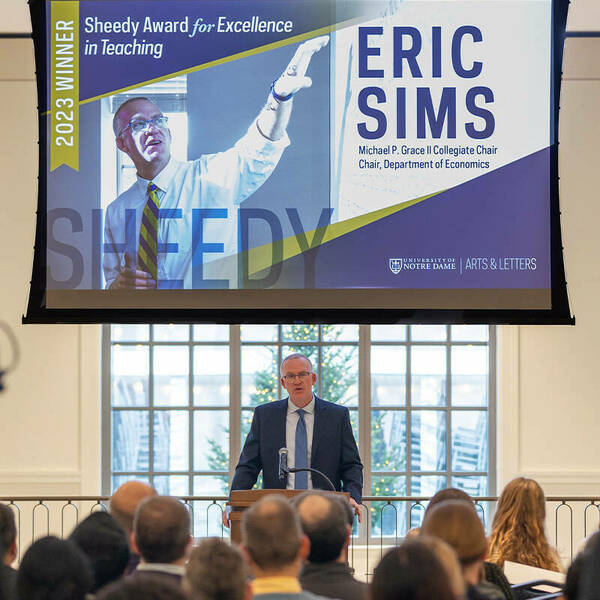
Eric Sims is the Michael P. Grace II Collegiate Chair and current chair of the Department of Economics. A member of the Notre Dame faculty since 2009, he is a macroeconomist whose research focuses on business cycles and monetary and fiscal policies. Sims teaches classes in macroeconomics and monetary policy at both the undergraduate and graduate levels and is a past recipient of the Rev. Edmund P. Joyce, C.S.C. Award for Excellence in Undergraduate Teaching. He has also co-authored an online textbook for use in intermediate macroeconomics courses.
Sims received the Sheedy Award for Excellence in Teaching at a ceremony on Wednesday, Dec. 6, in the new Raclin Murphy Museum of Art.
“Eric Sims has a special gift of transmitting his love for the subject to his students and stimulating a thirst for knowledge and inquiry among his students. His commitment to teaching goes beyond delivering lectures and developing skills but is driven by the strong desire to make a difference in students’ lives.”
Previous Award Recipients
| Year | Recipient | Media | Department |
|---|---|---|---|
| 2023 | Eric Sims | Video, Speech, News story | Economics |
| 2022 | John Duffy | Video, Speech, News story | English |
| 2021 | Kathleen Sprows Cummings | Video, Speech, News story | American Studies and History |
| 2020 | Pamela Wojcik | Video, Speech, News story | Film, Television, and Theatre |
| 2019 | Jason Ruiz | Video, Speech, News story | American Studies |
| 2018 | Ernesto Verdeja | Video, Speech, News story | Political Science |
| 2017 | Jessica Collett | Video, Speech, News story | Sociology |
| 2016 | Marisel Moreno | Video, Speech, News story | Romance Languages and Literatures |
| 2015 | Robert Sedlack | Video | Art, Art History, and Design |
| 2014 | John Sitter | Video, Speech | English |
| 2013 | Julia Douthwaite | Video | Romance Languages and Literatures |
| 2012 | Peter Holland | Video, Speech | Film, Television, and Theatre |
| 2011 | Thomas F.X. Noble | Speech | History |
| 2010 | James Collins | Speech | Film, Television, and Theatre |
| 2009 | Richard Pierce | Speech | Africana Studies |
| 2008 | James McKenna | Speech | Anthropology |
| 2007 | Daniel Myers | Speech | Sociology |
| 2006 | Christian Moevs | Speech | Romance Languages and Literatures |
| 2005 | Gail Bederman (co-recipient) | Speech | History |
| 2005 | William Ramsey (co-recipient) | Speech | Philosophy |
| 2004 | William H. Leahy (co-recipient) | Speech | Economics and Policy Studies |
| 2004 | A. Peter Walshe (co-recipient) | Speech | Political Science |
| 2003 | Valerie Sayers | Speech | English |
| 2002 | Andrew Weigert | Student reflections: Christopher Broughton, Eugene Kang, and Sarah MacMillen | Sociology |
| 2001 | Stephen M. Fallon (co-recipient) | Speech | Program of Liberal Studies |
| 2001 | Wilson “Bill” Miscamble, C.S.C. (co-recipient) | Speech | History |
| 2000 | Reginald F. Bain | Speech | Film, Television, and Theatre |
| 1999 | Douglas Kinsey | Speech | Art, Art History, and Design |
| 1998 | Erskine Peters | English | |
| 1997 | Frederick J. Crosson | Program of Liberal Studies | |
| 1996 | Catherine LaCugna | Theology | |
| 1995 | A. James McAdams | Government and Int’l Relations | |
| 1994 | Rev. Robert Kerby | History | |
| 1993 | Jeanne Day (co-recipient) | Psychology | |
| 1993 | Timothy Scully (co-recipient) | Government and Int’l Relations | |
| 1992 | Thomas Swartz | Economics | |
| 1991 | William Krier | English | |
| 1990 | Sonia G. Gernes | English | |
| 1989 | Richard F. Foley | Philosophy | |
| 1988 | Rev. George Minamiki, S.J. | Modern & Classical Languages | |
| 1987 | Cornelius Delaney | Philosophy | |
| 1986 | James O. Bellis | Anthropology | |
| 1985 | M. Katherine Tillman | Program of Liberal Studies | |
| 1984 | Frank Bonello | Economics | |
| 1983 | John Roos | Government and Int’l Relations | |
| 1983 | Paul Rathburn | English | |
| 1982 | Sheilah Brennan | Philosophy | |
| 1981 | Thomas Werge | English | |
| 1980 | Donald Sniegowski | English | |
| 1979 | Rev. Thomas Blantz, C.S.C. | History | |
| 1978 | Rev. John Dunne, C.S.C. | Theology | |
| 1977 | Edward Cronin | Program of Liberal Studies | |
| 1976 | Ernest Sandeen | English | |
| 1975 | Matthew Fitzsimons | History | |
| 1974 | Michael Loux | Philosophy | |
| 1973 | Robert Vacca | Modern & Classical Languages | |
| 1972 | William Storey | Theology | |
| 1971 | Frank O’Malley | English | |
| 1970 | Joseph Evans | Philosophy |