
The beauty of fine art, the story the artist tells, and the emotions it stirs in the viewer are on full display at the Graduate School in Bond Hall. These works, selected for the Graduate School’s annual fine arts show, Solarium 25, feature a juried sampling of artistic explorations created by eight talented University of Notre Dame master of fine arts students. This signature event is held each spring, and this year’s event was made even bigger, as students in the English master of fine arts (MFA) program — also known as the creative writing program — were chosen to view the art and write an ekphrastic reflection, which is displayed alongside the original piece.
Solarium 25’s opening reception took place on March 5, with artists, writers, and nearly 100 members of the Notre Dame community in attendance to celebrate the work.
“Today, we recognize the importance of the unique and powerful contributions of Notre Dame’s MFA students in art, design, and writing to our University,” said Michael Hildreth, Ph.D., dean of the Graduate School, associate provost and vice president for graduate studies, and professor of the Department of Physics and Astronomy, “and we honor and celebrate the many ways these students research, interrogate, and interact with events in our world today and with the very experience of being human.”
“The opportunity to collaborate with the Graduate School and foreground the research produced by our MFA students in studio and design is one of the highlights of our spring semester each year,” added Jason Lahr, associate professor in the Department of Art, Art History, and Design and director of graduate studies for the MFA programs in studio art and design. “Not only do our students gain recognition for their work, but they also gain valuable professional experience through the process of hosting jurors from the Graduate School in their studios and in collaborating in the installation of their work.”
Exploring modern problems
The students featured in Solarium 25 utilize their art to explore some of the most pressing issues of contemporary life. One theme that appears is the examination of gender roles that compartmentalize or even erase women’s achievements in science or art. Another overarching theme is personal autonomy, particularly when that autonomy is compromised, threatened, or even denied by governments or one’s fellow humans. The creative writing students also creatively responded to these themes in their ekphrastic reflections.
What is an ekphrastic reflection? Paul Cunningham, creative writing program manager in the Department of English, said that in the past, the term “ekphrasis” has been defined as “a literary device in which a painting, sculpture, or other work of visual art is described in detail. Think Keats’s ‘Ode on a Grecian Urn,’” he suggested. Today, Cunningham said, “writers use ekphrasis to translate existing visual artworks into new poems and stories.”
The pairings — the artist and the creative writer chosen to write about the exhibit — are listed below.
| Artist | Writer |
|---|---|
| Norah Ruth Amstutz (Ceramics): The Last Supper (excerpt) | Daryna Gladun: Porcelan Memory welcomes Norah Ruth Amstutz to The Last Supper |
| Sara Motallebi (Visual Communication Design): Flow, Interrupted | Isabelle Boutiette: OR CROSSING STREETS LIKE LETTERS |
| Lucy Schultz (Industrial Design): Away Home | Proph Dauda: THIS PAINTING IS A RAFT TO MY HOME |
| Griffin Liu (Sculpture): No Exit | Adriana Toledano Kolteniuk: (2) Two (NO) EXIT |
| Thomas Callahan (Photography): a list of things I want |
Ryan Phung: List of things yet to know they will become a list, beings |
| Heidi Dargle (Visual Communication Design): Miss Atomic | Oli Peters: |
| Claire Murphy (Painting): Intervention | Emilaino Gomez: APAPHASIS |
| Emma Brooks (Design): Joy, Activism, & Buttons | Helen Quah: Safety Pin |
The creative writers had just short of 20 hours to craft their response of 300 words or fewer, and the results were impressive.
“When students are face-to-face with a different visual medium, they elevate their diction, allowing them to try stylistic risks they might not normally take,” Cunningham said.
Solarium 25 art and ekphrastic award winners
Visual artists Griffin Lui, Sara Motallebi, and Emma Brooks claimed top prizes.
Isabel Boutiette, Helen Quah, and Oli Peters won the top awards for their ekphrastic reflection pieces.
Best in Show: Griffin Liu (sculpture), No Exit

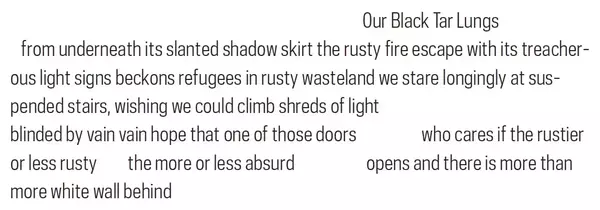
Through a surreal miniature landscape titled No Exit, sculptor Griffin Liu said he aimed “to explore the tension between governmental control and human agency.” Liu, who drew from personal experience as a political refugee, crafted two exit doors connected by a fire escape, creating a sense of entrapment despite the promise of escape. The piece features both doors bearing exit signs, yet they lead nowhere. It includes precision-cut shapes for the railings and doors, as well as laser-cut signs, ensuring architectural accuracy. Even the most minor details were painstakingly tended to as Liu used acrylic paint to weather the surfaces, enhancing the worn, aged appearance and reinforcing the feeling of an unsettling, trapped atmosphere. His installation will undoubtedly resonate with many at a time of great turmoil in the United States and worldwide.
Creative writing student Adriana Toledzano Kolternik artfully composed the ekphrastic reflection accompanying Liu’s sculpture. The ending fragment of her composition:
Best Artist: Sara Motallebi (Visual Communication Design), Flow, Interrupted

Sara Motallebi probes memory, trauma, and identity in her installation Flow, Interrupted.
Motallebi’s art draws on memories surrounding the death of 22-year-old Jina Mahsa Amini on September 16, 2022 — a death widely believed to be at the hands of the Islamic Republic regime’s notorious morality police for Amini’s alleged improper hijab. Amini’s death sparked the Women, Life, Freedom movement, which was met with brutal repression and resulted in at least 500 deaths in Iran, human rights groups estimate.
Motallebi’s installation takes up the theme of “digital amnesia.” Many Iranians, Motallebi included, erased photos from their phones, “an action born of fear, survival, and resistance.” The artist’s work uses monoprints of the same image of Nika, a 16-year-old protester. Through layers of transparent prints, shadows, and text, fragmented images blur what is present and what has been erased.
“It invites viewers to reflect on the fragility of remembrance and the persistence of resistance against erasure,” Motallebi said.
Creative writing MFA student Isabel Boutiette, who received first place honors for her creative writing about Motallebi’s piece in the Solarium show OR CROSSING STREETS LIKE LETTERS, describes her process of response to the installation: “It was important to me to integrate Sara’s idea of erasure and absence into the work. I wanted each quatrain in the sequence to leave open-ended, signaling a gap in the text. I tried to incorporate the violence of what her work bore witness to, and I really wanted to draw attention to the importance and power of ‘witness’ in her work, even under the pressures of state-backed erasure and censorship.”
People’s Choice: Emma Brooks (Design), Joy, Activism, & Buttons

Emma Brooks won the People’s Choice Award for Joy, Activism, & Buttons, a unique and joyful work designed to spark activism. Brooks produced her installation through a collaboration with Goshen College’s Prevention Intervention Network (PIN), using pinback buttons as the primary medium, along with stickers, door hangers, and T-shirts, all while promoting a message of consent and aiming to dismantle rape culture. Two examples of text on the buttons: “We look out for each other” and “Consent is my cup of tea.” Brooks also designed a toolkit to empower the PIN students, featuring custom stamps, ink, and button templates to create their own buttons. It is a weighty topic, but Brooks also infused her work with another quality: joy.
“The experience of creating the buttons together is enriching, fun, and joyful while ensuring consistency and reinforcing PIN’s brand recognition,” she said.
Brooks explained that she is inspired by the work of designer Ingrid Fetell Lee and her philosophy around the aesthetics of joy.
“Activism can be heavy,” Brooks said. “Joy is more sustainable, as it embodies the drive for life itself.”
Creative writing student Helen Quah’s accompanying ekphrastic reflection, titled Safety Pin, was awarded first runner-up honors in the Solarium show. In it, she describes sensations and memories linked to the swallowing of a pin and waiting for “a jolt of pain or tingly itch” that would “get me wondering about the little creature.” This symbol of the safety pin, she explained, “a small sharp everyday object, was a way for mine and Emma’s work to collide, exploring ideas of concealment, shame, and their relation to violence against women.”
Furthermore, Quah found great joy in the intertwining of their work during Solarium 25.
“I found this Solarium ekphrasis a really enjoyable challenge to engage deeply with the work of Emma Brooks,” she said. “Her constellation of pin badges and stamps aimed to promote discussions about women’s safety and consent, which was remarkable. I found myself quickly engaging with the art through a fiction story that focused on the image and object of the safety pin from a first-person, young girl’s perspective.”
Ekphrastic reflection: second runner up, Oli Peters
Oli Peters, who won second-runner-up honors for her ekphrastic reflection, “Miss A-Bomb,” imaginatively crafted a character to bring Heidi Dargle’s museum-style exhibit Miss Atomic to life. Peters provides this context for her work:
I hoped to communicate the complexity and layeredness of Dargle’s piece. I attempted to do this by turning Miss Atomic into a character and generating a narrative that began with her winning the pageant. From there, I was able to weave in some of the striking details that the artist presented in her work: the lipstick-stained uranium tea cup, the images of the women who survived the A-bomb blast then traveled to the US to get corrective plastic surgery, the gas mask, the history-forgotten women who helped put the bomb together. I also wanted to harness the strange and contradictory version of femininity that Miss Atomic represented, which Heidi adeptly probed and questioned.
In every pairing, artists representing completely different mediums found a powerful way to come together and tell a story. Whether they were chosen as winners, learned a new perspective, solidified their own, or honed their creative skills, they all walked away with a richer understanding of art, ekphrastic reflections, and perhaps themselves.


Originally published by at graduateschool.nd.edu on February 13, 2026.


