
A quarter century after the terrorist attacks of September 11, 2001, a panel of distinguished guests related their harrowing firsthand experiences of the tragic day and its aftermath at the University of Notre Dame's Center for Citizenship & Constitutional Government's 2026 Jeanie Poole O’Shaughnessy Memorial Lecture.
The panel consisted of U.S. Supreme Court Associate Justice Brett Kavanaugh; Notre Dame president emeritus Rev. Edward A. “Monk” Malloy, C.S.C.; former March for Life president Jennie Bradley Lichter '04; and Piper Sandler vice chairman and senior managing principal James J. “Jimmy” Dunne.
Notre Dame President Rev. Robert Dowd, C.S.C., opened the program by recalling his own experience as a graduate teaching assistant and leading a prayer of remembrance. Tocqueville Fellow and senior Will Carlson then led the pledge of allegiance, and Tocqueville Fellow, CCCG intern, and senior Angela Moreno introduced the members of the panel.
CCCG founder and director Professor Vincent Phillip Muñoz facilitated the conversation, and panelists ensured that the audience in the DeBartolo Performing Arts Center would not forget the sobering day.
The speakers’ proximity to September 11’s events ranged from New York City, to the White House, to Notre Dame’s campus, and offered a breadth of insights.
"It was very thought-provoking to hear the stories of the day from a former Notre Dame student all the way up to a Supreme Court Justice,” said Joe Manning , a sophomore majoring in history, who attended the lecture. “The panel’s cumulative experiences demonstrated the intertwined stories of 9/11 and the University of Notre Dame."
On Sept. 11, Jimmy Dunne '78 (who currently serves on the University’s Board of Trustees) was a senior managing principal at Sandler O’Neill + Partners located in the South Tower at the time. Dunne was out of the office on that morning, playing golf, when he heard the news.
“I buckled, and I hit the ground,” Dunne said emotionally.
At the time of the attacks, the now-Justice Kavanaugh worked in the White House as an associate counsel to the U.S. President. He described how “Secret Service came down to the basement and said ‘You gotta run, you gotta sprint.’” When asked where the staff was supposed to evacuate, the Justice responded, “We didn’t have anywhere to go.” His narrative underscored the chaos and fear experienced in Washington that day.
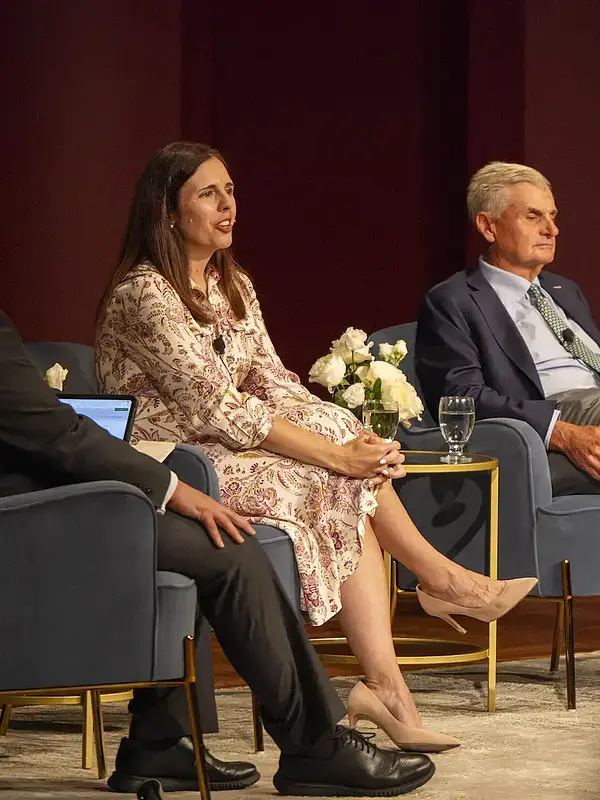
Jennie Bradley Lichter was an undergraduate student at the time and experienced the events from her dorm room in Lyons Hall.
“It didn’t make any sense,” she said. "(We) spent the rest of the morning watching TV and being together, which was all we really could do.”
As president of the University, Fr. Malloy had to react with composure to prevent panic and ensure the safety of students and staff. He recalled telling staff that the “first thing we’re gonna do is worry about the students and their families.”
He canceled classes for the rest of the day and quickly organized a Mass to be held on South Quad.
“We walked out, and it was utter silence,” Malloy said.
In his homily, he invoked Matthew 11:28: “Come to me, all who labor and are heavy laden, and I will give you rest.”
Rather than holding hands for the Our Father, the congregants locked arms, a testament to the supportive nature of the campus community in an uncertain time.
Each panelist emphasized how inconceivable September 11 truly was, helping the undergraduates in the audience, born after 2001, better appreciate the significance of the event.
Lichter’s framing of the shocking events around familiar campus experiences allowed her to serve as a “way-back time machine for the students in the audience.” Conveying the stunning nature of the day, Justice Kavanaugh recalled thinking at the time “this doesn’t happen in America.” Dunne, directly addressing the students, explained that while “terrorism is now in our psyche, it was not then.” The events permanently altered Americans’ frame of mind.
"One thing that Jimmy [Dunne] did really well was help us have the same feeling, and understand deep down what it felt like to be an observer [of 9/11],” said senior Thomas Mitchell.
While the panelists shared their grief and sorrow, they also offered optimistic insights. Justice Kavanaugh's message for students was that “we have much more in common as Americans” than today's divisions suggest.

Dunne emphasized that even the most accomplished people cannot be isolated from adversity. “These are the greatest minds that we have,” he said, referring to his fellow panelists. “The thing I would want young people to understand is that you’re going to have serious and significant challenges. Bad things are going to happen, so you want to get yourself where you're preparing early for that.”
Dunne’s counsel of preparation for adversity resonated with students. Tocqueville Fellow and junior Jack Rankin said that the stories made it “the most inspiring panel I’ve been to at Notre Dame.”
The full event recording can be viewed on our YouTube channel. To stay in touch with the Center for Citizenship & Constitutional Government and be the first to know about upcoming events, subscribe to our mailing list here.
The Jeanie Poole O’Shaughnessy Memorial Lecture was established in 2022 after the death of the Center’s beloved friend and supporter in 2021 and made possible by Patrick O’Shaughnessy and the O’Shaughnessy Family.
This endowed lecture is designed to connect scholarship and education concerning the ideas and institutions of constitutional government with the principles put into practice by the individuals shaping the civic fabric of our country.
Originally published by at constudies.nd.edu on September 30, 2026.


