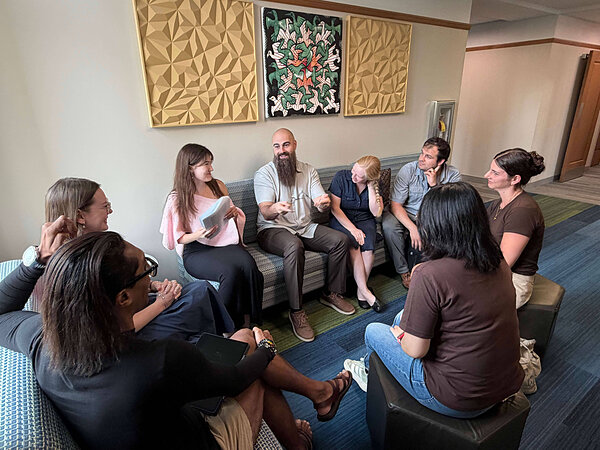
Most graduate students arriving back on campus in the fall are required to undergo some form of orientation, but for the latest cohort of Graduate Fellows at the University of Notre Dame’s Institute for Ethics and the Common Good (ECG), the start to the year consisted of a five-day deep dive meant to jumpstart interdisciplinary collaboration, build relationships, and invite wrestling with one of today’s thorniest real world ethical issues.
From Aug. 10 to 14, ECG’s inaugural Graduate Ethics Bootcamp brought together all 12 graduate gellows — five Wilsey Distinguished Graduate Fellows and seven Tech Ethics Graduate Fellows — whose fields span the social sciences, engineering, computer science, and the humanities. The bootcamp was led by Megan McDermott, director of the Notre Dame-IBM Technology Ethics Lab, and Jeffrey Tolly, associate director of education and student research at ECG, with daily input from Meghan Sullivan, director of ECG and the Notre Dame Ethics Initiative, and Wilsey Family College Professor of Philosophy.
The week included interactive seminars that offered an overview of three major moral theories — utilitarianism, rule-based ethics, and virtue ethics — and invited the fellows to engage these theories in dialogue with the tools of their own discipline.
A centerpiece of the week, the bootcamp capstone project involved breaking the fellows out into four-person cohorts to review the “Claude Constitution,” an 84-page document published by frontier artificial intelligence lab Anthropic, that the company says “sets the core values, safety rules, and ethical reasoning framework” for all Claude AI models. Fellows were asked to read the constitution twice and work in their small groups to propose amendments for their peers to consider.
"There's no better way to explore how moral theory applies to the complexities of real life than by carefully investigating a current use case that touches on several disciplines and spheres of life,” said Tolly. “Claude's Constitution proved to be just that, as we were so encouraged to see how this exercise pushed our graduate fellows into deeper self-reflection and critical examination of the moral stakes involved with designing powerful AI."
Emelia Hughes, current Technology Ethics Graduate Fellow and doctoral candidate in computer science at Notre Dame, found the exercise useful for helping to broaden her own initial reactions to the constitution, and helping her wrestle with her own knee-jerk reactions to its language and assumptions. She found herself challenged by a philosophy student in her group to really spend time entertaining questions about Claude’s consciousness or lack thereof, and potential implications of either assumption.
“Throughout the bootcamp, it was really interesting to encounter others at this moment where we’re all so deep in our own areas and knowledge fields, and to realize that we can collaborate despite our differences,” said Hughes. “Oftentimes exercises like this are surface level enough that you don’t actually share knowledge, but reviewing the constitution gave us a chance to go deep into each other’s fields and teach each other.”
Each group had a chance to present their proposed amendments to the full graduate cohort on Aug. 24, with proposals addressing wide-ranging questions raised by the rapid development of artificial intelligence and the Claude constitution in particular. Proposed amendments suggested broadening Claude’s understandings of harm, asking for clarity in how the model weighs conflicting values, wrestling with the moral implications of Claude being programmed to be maximally helpful, and advocating for more honesty and transparency from frontier AI labs.
In the end, the bootcamp laid the foundation for important interdisciplinary collaboration among fellows to continue throughout the coming academic year, and gave fellows the tools to begin thinking about how best to address critical ethical issues in their own academic arenas.
“I immediately realized that if I needed guidance on particularities of deep theory or cognitive science there were people and resources to go to,” said Westin Smith, Ph.D. candidate in Spanish at Notre Dame. “Everyone added their own flavor to our discussions on Claude, and that really helped illuminate how multifaceted these questions are. At the end of the day, everyone’s trying to grapple with big questions, and it’s fun to be able to help each other.”
The Notre Dame–IBM Technology Ethics Lab — a critical component of the Institute for Ethics and the Common Good and the Notre Dame Ethics Initiative — promotes interdisciplinary research and policy leadership in technology ethics and is supported by a $20 million investment from IBM.
The Wilsey Distinguished Graduate Fellows are drawn from the College of Arts & Letters, bringing humanistic and social scientific perspectives to bear on complex moral questions. The 2026–27 cohort of Wilsey Distinguished Graduate Fellows is supported by a John Templeton Foundation grant, aimed at developing love-based ethical frameworks.
Originally published by at ethics.nd.edu on September 10, 2026.


