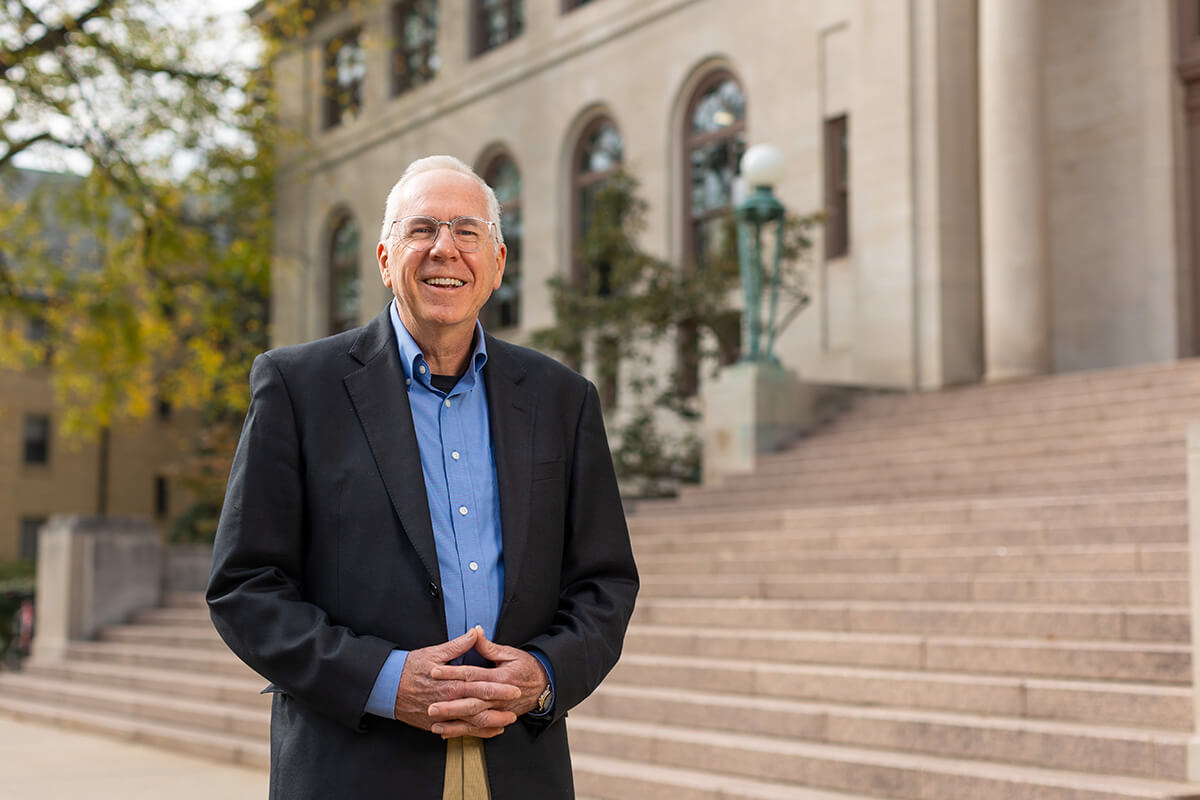
On a Tuesday afternoon more than 30 years ago, Mark Roche was terribly underprepared to teach.
As he worked early that morning to prepare for a three-hour graduate seminar, he was interrupted by two phone calls — the first from a fellow professor, the other from his wife.
The colleague asked if they could observe his class that day, and Roche said yes, intensifying his preparation.
But the second call cut that short: Roche’s wife needed him to clean the house before a meeting with their real estate agent and a potential buyer.
In a decision he called risky but obvious, Roche helped his wife and showed up to class with no planned lecture.
“And it was one of the best classes I’ve ever taught,” he said.
“What stood out the most to me about Professor Roche was the genuine sense of support he provided and the strong community he created among our class. It was clear from the start that he saw us as individuals and cared about our college experience beyond simply his class.”
— Keira Stenson, Notre Dame senior
Roche depended on his students’ thoughts more than his own that day. He asked more questions, pulling the students into contact with the day’s reading, pushing them to think more deeply.
“I’ve never prepared a class that way again, but it did teach me a lesson,” he said. “What you’re really teaching is the material through the students, not what you have prepared.”
Student-centered teaching ultimately became Roche’s pedagogy, and after nearly 30 years as a German and philosophy professor at the University of Notre Dame, it has earned him the College of Arts & Letters’ highest teaching award.
The Sheedy Award for Excellence in Teaching was founded in 1970 in honor of Rev. Charles E. Sheedy, C.S.C., who served as dean of the College of Arts & Letters from 1952 to 1968. It acknowledges a faculty member who has sustained excellence in research and instruction over a wide range of courses. Recipients demonstrate a commitment to motivating and enriching students through innovative and creative teaching methods and influence teaching and learning within the department, College, and University.
Roche will be honored at a ceremony and reception at McKenna Hall on Tuesday, Dec. 2, beginning at 3:30 p.m.
His impact is evident in the intellectual passion he has instilled in his students and in the broader College and University community.
“I would like to become a professor someday,” wrote Naya Tadavarthy ’22 in her nomination letter, “and hope to employ the same level of thoroughness in my work, dedication to my teaching, encouragement of my students, and enthusiasm for my field as him.”
Leading with vision
When Roche initially came to Notre Dame, he didn’t teach much at all.
In 1996, after 12 years at The Ohio State University, Roche became the Rev. Edmund Joyce, C.S.C., Professor of German Language and Literature, a concurrent professor of philosophy, and chair of his department. But only a year later, he began his 11-year tenure as the I.A. O’Shaughnessy Dean of the College of Arts & Letters.

As dean, Roche taught only one course a year and didn’t have any time to initiate new research projects. He admits this wasn’t an ideal situation for someone who loves teaching and writing, but he didn’t let his time at the helm of the College go to waste — he had too much work to do.
Roche’s primary leadership goal was to push the College to fully realize Notre Dame’s mission — the identity that drew him to the University in the first place.
“Notre Dame is a traditional liberal arts college with a long-standing emphasis on teaching, deeper than many other research universities,” he said. “The overlap of teaching and research is central to what we do.”
While not teaching much himself, Roche made it a central piece of his administrative efforts.
As dean, he oversaw the development of the College Seminar, a collection of unique one-semester interdisciplinary courses, with the requirement that each Arts & Letters student take one. Fueled by Roche’s belief in discussion-based learning, CSEM prioritizes oral communication skills and builds student confidence in personal expression through discussion sessions, professional interviews, and presentations.
CSEM is also designed to grab students’ attention with big questions worthy of extensive consideration and conversation. One question, for example, posed in Roche’s Faith, Doubt, and Reason CSEM course is, “What obstacles exist to faith?”
To answer the big questions, students discuss potential answers with one another and explore a variety of readings and sources, ranging from the writings of Pope John Paul II to data sets on American voting patterns.
“They’re learning to speak, they’re getting breadth, and they’re addressing topics that mean something to them personally,” Roche said.
Roche’s leadership was constantly guided by his vision of what a Catholic liberal arts education should be — what students should know, and what they should be able to do.
Now, 17 years since Roche stepped down from administration, he said he’s glad to stay in the classroom. In fact, he’s more enthusiastic than ever about teaching.
“I find myself coming into class, ready to teach Oedipus at Colonus, and thinking, ‘I can’t believe I get paid to do this,’” he said. “I want to teach as much as I can.”
Developing essential virtues
One of Roche’s favorite classes to teach is a two-semester honors humanities seminar — Great Works of Literature and Culture from Homer to the Present — during which he aims to win students over on the first day.
After a name-engagement icebreaker, Roche challenges students by putting them into small groups and asking the question, “What are the marks of the best discussion classes you’ve ever had?”
Students write down the qualities of both good and bad discussions, and then decide who is responsible for which aspects of that experience. The University provides the classroom, Roche provides the topic, the texts — and some light moderation — but ultimately, the course is the students’ responsibility.
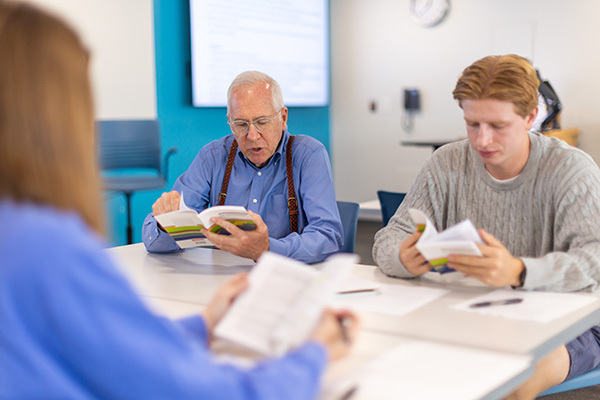
“When you see the students interacting with one another at such a high level, you can almost recede,” he said. “You realize you have created an environment that students have stepped into and seized control of. They take ownership of their learning.”
For Roche, the excitement in asking great questions and engaging with complex work is the essence of a college education, and the strongest argument in favor of the liberal arts.
Throughout his career, he has considered how to best convey the value of a liberal arts education, especially in an increasingly results-based world. The issue has inspired much of his work, including his 2010 book, Why Choose the Liberal Arts?
A staunch advocate for the humanities, Roche emphasizes the essential skills provided by the liberal arts, including writing, analysis, and collaboration. But what’s more important, Roche said, are the virtues that naturally develop as part of rigorous discussion.
In a productive discussion class, students learn justice by taking everyone’s position seriously and weighing it in the light of reason. They learn courage by defending their position when they’re in the minority. And they learn intellectual hospitality by connecting their ideas with those of their classmates.
For Roche, these virtues make the liberal arts necessary — and help students develop into better people and better leaders.
“The ultimate purpose of a liberal arts education is to help you develop a sense of vocation,” he said, “and the capacities to fulfill it.”
Juggling teaching and creating
Roche’s academic career began with a Fulbright fellowship in Germany after he graduated from Williams College. He connected with the language that tied into his scholarly work and became familiar with a different model of teaching and learning.

Had he not gotten the Fulbright, he still had plans to further his education — by attending clown school. Though wildly different career trajectories, both paths had one thing in common.
“What I wanted from being a clown was to experience the joy of doing something for its own sake,” he said. “I would say in teaching, you get that in spades.”
While Roche continued in higher education and ultimately earned his Ph.D. in German literature from Princeton University, he still developed an appreciation for juggling — teaching and research, that is.
To keep those pins in the air, Roche draws research inspiration from his teaching. After his first two books on German literature, he moved to broader questions, writing about the philosophy of tragedy (inspired by a course he taught) and literature’s place in the technology-oriented 21st century.
As his academic career progressed, his work increasingly conveyed his thoughts on education, with books inspired by his time as dean, such as The Intellectual Appeal of Catholicism and The Idea of a Catholic University.
Roche’s more recent books on film and art draw on texts and realizations scattered across his teaching career. One of his current projects explores proleptic interpretation — or the practice of creating counterarguments — a concept made familiar to Roche by decades of discussion classes.
That ever-expanding intellectual curiosity serves as an inspiring model for his students and his colleagues.
“Mark is here to tell students that they do not need to channel their joy of learning into narrow pathways,” wrote Tobias Boes, chair of the Department of German, Slavic, and Eurasian Studies, when nominating Roche for the Sheedy Award. “They can do it all: pursue an academic passion, study a language, go abroad to conduct advanced archival research, formulate an independent research project, learn an instrument, and yes — go to a football game on the weekend. He is a relentless cheerleader for all these pursuits, and he regularly uses both his personal connections and his development funds to open doorways for his students.”
With three books published in the past three years — one on Alfred Hitchcock and two on aesthetics and ugliness — Roche continues to prove himself to be quite the juggler. He’s found success in all three areas of his profession — research, teaching, and leadership — and has built a layered legacy that reflects the University he calls home.
“What stood out the most to me about Professor Roche was the genuine sense of support he provided and the strong community he created among our class,” wrote senior Keira Stenson. “It was clear from the start that he saw us as individuals and cared about our college experience beyond simply his class.”


