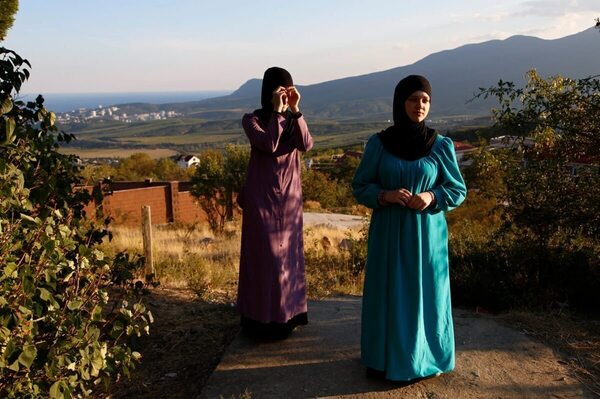
Join this upcoming panel event with the Nanovic Institute and the Ukrainian Studies Hub at Notre Dame.
Ukraine’s Autonomous Republic of Crimea – under Russian occupation since 2014 – is a pivotal strategic and symbolic arena in the largest land war in Europe since 1945. Yet we still know little about its distinct history, rooted in the arts and identity of the Black Sea peninsula’s indigenous Crimean Tatar people. In this lunchtime panel, renowned international scholars of literature, music, and visual arts shed urgent light on living Crimean Tatar and Ukrainian culture in Crimea, which has endured centuries of empire, exile, and erasure — and whose recovery is now, more than ever, a matter of historical justice.
Lunch will be available beginning at 12:00 p.m., while supplies last, and a Ukrainian cake will be served after 1:30 p.m. for a brief reception.
Panelists
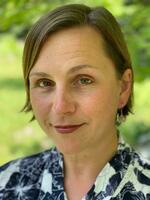
Maria Sonevytsky is associate professor of anthropology and music at Bard College in New York. She is the author of Wild Music: Sound and Sovereignty in Ukraine (2019), and Vopli Vidopliassova’s Tantsi (2023), as well as more than a dozen academic articles and book chapters, including numerous works on the music of Crimean Tatars and the politics of post-Soviet indigeneity. Her current book project examines Soviet musical childhoods at the Kyiv Palace of Pioneers.

Nataliya Shpylova-Saeed is a memory studies researcher and literary critic. She writes on cultural memory, focusing on Ukraine and Russia. Her book, Russia’s Denial of Ukraine: Letters and Contested Memory, was published in 2024 (Lexington Books Press), and she is a co-editor of Crimean Fig/Qirim Inciri: Contemporary Crimean Tatar Poetry and Fiction (Arrowsmith, 2025). Her current research project is Russia’s Memory of the Past: The War Against Ukraine and the Forgotten Future. Nataliya Shpylova-Saeed teaches Ukrainian at Harvard University in the Department of Slavic Languages and Literatures.
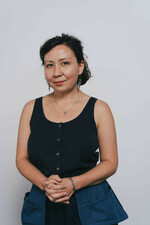
Emine Ziyatdin is a Ukrainian Crimean Tatar visual artist, documentary photographer, and researcher. She was born in Uzbekistan, where her family was deported by the Soviet regime along with the entire population of Crimean Tatars in 1944. In 1990, her family returned to Crimea.
Her work explores themes of home, belonging, and collective memory through both visual and research-based approaches. She holds an M.A. in sociology from Ivan Franko National University of Lviv and an M.A. in photojournalism from Ohio University’s School of Visual Communication. Her work has been supported by a Fulbright Scholarship and the Magnum Foundation Emergency Fund Fellowship. Emine’s work has been exhibited in Ukraine and internationally. She is currently based in London, UK.
Moderator

Rory Finnin is professor of Ukrainian Studies at the University of Cambridge. He established the Cambridge Ukrainian Studies program in 2008.
Finnin has curated and organized over 40 exhibitions and cultural events, advancing public understanding of Ukraine’s language, history, and society in the UK and beyond. His research focuses on the interplay between culture and identity in Ukraine, with particular attention to Crimea and Crimean Tatar literature, and his broader interests include nationalism studies, solidarity studies, and cultural memory in the region of the Black Sea. Finnin received his Ph.D. in Slavic languages and comparative literature from Columbia University. He is also a Returned Peace Corps Volunteer (Ukraine, 1995-97). Finnin has published extensively, and his book, Blood of Others: Stalin’s Crimean Atrocity and the Poetics of Solidarity (University of Toronto Press), has received eight international awards, including the 2024 Laura Shannon Prize in Contemporary European Studies, administered by the University of Notre Dame’s Nanovic Institute for European Studies. Professor Finnin has also served as Head of the Department of Slavonic Studies and Chair of the Cambridge Committee for Russian and East European Studies.
Originally published at nanovic.nd.edu.